

Living together as husband and wife is commonly found in Thai society. Many couples live together, have assets, children, and shared responsibilities, but have not legally registered their marriage. This leads to misunderstandings about “spousal rights” which, according to law, only arise when marriage is officially registered. How do the legal rights and consequences of living as husband and wife differ between “registered” and “unregistered” marriages, and how should assets, children, and inheritance be managed?
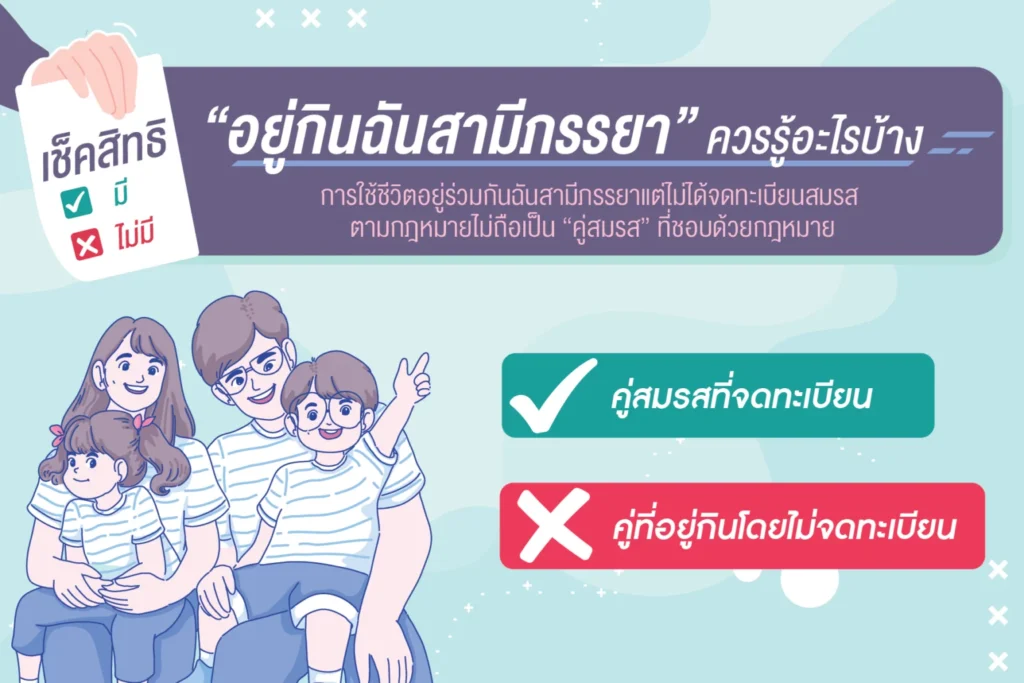
Rights of spouses who have “registered their marriage” under the law include the following important rights:
- Joint marital property. Assets acquired during marriage are considered “marital property” (unless agreed upon in writing to be personal property), such as income, jointly purchased assets, or even assets purchased by either party during the marriage.
- Legal inheritance rights. Spouses have the right to inherit from each other as statutory heirs.
- Right to claim alimony upon divorce. If the divorce is due to the fault of one party, the injured spouse has the right to claim alimony if they become impoverished after the divorce.
- Right to make medical decisions for the spouse in case they are ill and unable to give consent themselves.
- Right to receive benefits such as medical care rights or welfare from the state and various organizations.
- Children born during marriage are automatically considered “legitimate children” under the law. The father has legal rights to the child without needing additional child acknowledgment procedures.
Rights that “do not exist” when living together without marriage registration. Even if living together like husband and wife, if marriage is not registered, there are no legal rights as follows:
- No shared marital property. Assets are considered to belong only to the buyer or the person named as the owner.
- No inheritance rights. Unregistered couples are not each other’s statutory heirs.
- No right to claim alimony when separating, regardless of how long they have lived together.
- No right to make medical decisions for the partner, even if they care for each other like family.
- No right to receive benefits as a spouse, including welfare from the state, government agencies, or private sector.
- Children born must have “child acknowledgment” to have the legal status as the father’s legitimate child.